5. Rodrigo Castelazo Piña (2) (English)
Rodrigo Castelazo was widowed at the age of 49, in charge of eight children between the ages of 8 and 22. I suppose that the eldest daughter, Francisca, found herself in need of taking an active role in the care of the house and her siblings, although the other older brothers, Ignacio, 20, and Manuel, 17, were also old enough to help in the plight faced by a family that loses its mother.
Josefa died in Huasca, Hgo., when Rodrigo was already working in the mines of Real del Monte, owned by the III Count of Regla, Don Pedro José María Romero de Terreros y Rodríguez de Pedrozo.
The names of the three Counts of Regla are very long and similar, so I make a brief parenthesis to clarify who is who. These names are made very complicated by the custom of noble families to use the two surnames of their fathers and to lengthen theirs more and more in each generation, sometimes in one order and sometimes in another. Here I will use the style used in the Geneanet page of Sanchíz y Gayol.
The First Count of Regla was born on June 29, 1710 in Cortegana, Huelva, Spain, the son of José Felipe Romero Vázquez and Ana Gómez de Terreros Ochoa-Castilla. His name is usually spelled Pedro Romero de Terreros Ochoa y Castilla. He was named Count of Regla on December 7, 1768.
The Second Count of Regla was born on August 30, 1761 in Pachuca, Hidalgo, Mexico, the son of the marriage of the First Count of Regla to Maria Antonia Trebuesto Dávalos. His name is usually spelled Pedro Ramón Romero de Terreros Trebuesto y Dávalos.
The Third Count of Regla was born on November 1, 1788 in Mexico City, the son of the marriage of the Second Count of Regla with María Josefa Rodríguez de Pedrozo Cótera. His name is generally written as Pedro José Romero de Terreros Rodríguez de Pedrozo. However, in his book on the richness of the Biscayan vein, Rodrigo Castelazo cites him as "Pedro Josef Rodríguez Sáenz de Pedrozo Romero de Terreros Trebuesto y Dávalos".
Having closed the parenthesis on the Counts of Regla, we return to the story of
our famous ancestor. As was common at that time, Rodrigo did not wait long to
look for a new partner and on April 13, 1817, a few months before his 50th
birthday, he gets married in the Metropolitan
Cathedral with
María Rita Díaz Sustaeta, a 20-year-old maiden, originally from Mexico City.
His first child, Augustín, was born in San Miguel Regla in
1819 and the second, Juan Bautista, in Real del Monte, in 1820. In
this year, Rodrigo Castelazo published his report on the situation of the
Biscayan Vein, which remains to this day as one of the obligatory reference
works in the history of mining in Mexico. One of the original copies of this
text is in the catalog of the National Library, at the UNAM, but when I went to
look for it they informed me that it had been stolen, that is, someone stole
it. Could it be a Castelazo? I hope not. Another of the original copies I found
in the catalog of the University of Texas at Austin but there was no need to go
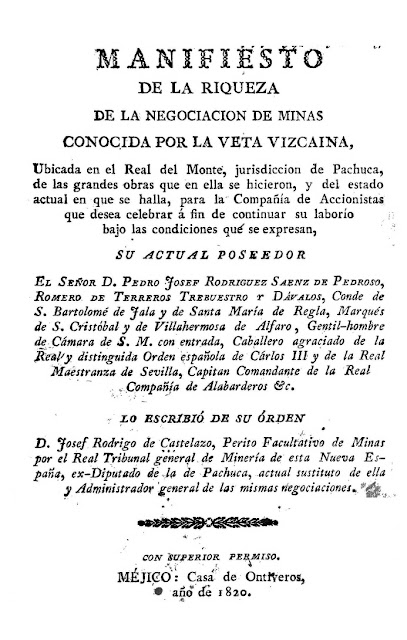
that far because the full text can be downloaded from a page in the Yale University, from which I have copied the cover
as a testimony of the authorship of Don Rodrigo.

Cover of the work published by Rodrigo Castelazo on the wealth of the mines of Real del Monte
The mines certainly no longer had the wealth that made the first Count of Regla, grandfather of Rodrigo's boss, one of the richest men in the world. They had been in decline because their owners did not have the necessary technology to drain the shots, which were increasingly flooded. The decision had been made to sell them and it was necessary to document their extension, conditions, available infrastructure, as well as the modest production that was still being achieved, in order to look for interested investors. On the cover it is read that Rodrigo Castelazo was the General Administrator of these "negotiations", as they called the company that owned the mines.
Shortly
after, Rodrigo and Rita moved to Mexico City and in 1822, already in independent Mexico, they had their third son, José Ramón, there. By this time, the
representatives of the Count of Regla were negotiating with English investors
to rent the mines, and their efforts were successfully concluded in 1824,
when agreements were signed with the "Company of Adventurer Gentlemen of the
Mines of Pachuca and Real del Monte," thanks to which the first English
immigrants arrived in that area. That same year, the fourth son of the Castelazo
Díaz family, Pedro, was
born in Real del Monte .
The mines
were not sold because at that time the sale of mines to foreigners was
prohibited. What was agreed was the right to exploit them in exchange for an
annual fixed income plus a percentage of the profits obtained by the
"aviator" company, as the company that took charge of the management
of the works was called. From 1824, the Count of Regla appointed Rodrigo
Castelazo as his representative to supervise the operations of the English
company, since it was necessary to ensure that the amount of production was
faithfully reported and the commission proportional to it was paid.
We do not
know the reason why the family spent a few years in Mexico, just during the
consummation of independence, but their return to Real del Monte could be
assumed to have been related to the resumption of work in the mines, given
their experience in the previous administration, which would surely be
considered of great value to the new owners.
I have not
found the birth certificate of José Antonio, the fifth child, but his death certificate records that he died in Huasca in
1848 at the age of 24, so he must have been born in 1824. On the same page
where the parish record of his death appears, the death of his half-brother
Luis, who had died thirteen days earlier, is found by coincidence. The fifth
child, José Ramón Roque, was born in Mexico City in 1827.
Rodrigo at the time was a state deputy in the State of Mexico, which at that
time included the present-day states of Mexico, Hidalgo and Morelos, and had
its capital in Tlalpan.
In that
year, an important intervention by Rodrigo Castelazo is reported to resolve a
strike in the mines of Real del Monte, caused by the reluctance of the English
company to pay the "party" or commission for ore extracted, to which
the miners were accustomed. Rodrigo reached the agreement thanks to his good
relations with the miners, who knew him very well, but also with the governor
of the state Lorenzo de Zavala and with the administrator of the English
company Charles Tindal.
Rodrigo
Castelazo was a deputy for the State of Mexico to the III Constituent Congress from 1829 to 1830, when he was a
delegation mate of Andrés Quintana Roo. Later he was deputy for the State of
Mexico to the V Constitutional Congress, from 1833 to 1834. In the delegation
of the State of Mexico to that legislature were also Andrés Quintana Roo, Juan
Álvarez and Pedro María Anaya. The latter was president of Mexico on two
occasions and was the famous defender of the Convent of Churubusco in the war
against the United States, who replied to Winfield Scott when the latter asked
him for the park after defeating him: "if there was a park you would not
be here". Juan Álvarez was a prominent military and politician, who
occupied the presidency of Mexico in 1855 by defeating the dictator Antonio
López de Santa Ana. He was the last president of the country to be born in the
eighteenth century and the last to fight in the war of independence. Quintana
Roo was of course one of the heroes and intellectuals of independence, a
collaborator of Morelos, husband of Leona Vicario and President of the Chamber
of Deputies from 1831 to 1832, among many other achievements in his life. His
remains, along with those of his wife, rest in the Independence Column. The
delegation of the State of Mexico to the V Constitutional Congress was composed
of 16 members and we suppose that Rodrigo Castelazo had the opportunity to get
to know these great men well.
On other
occasions we will have the opportunity to comment on what we know of other
Castelazo relatives who have been elected to the Chamber of Deputies:
1867-1869, Ismael Castelazo (alternate) and Manuel Castelazo; 1908-1912,
Eduardo Castelazo; 1912-1913, Manuel Castelazo Fuentes; 1958-1961, María Luisa
Martínez de Castelazo (alternate); 1994-1997, José Rafael Castelazo y de los
Ángeles (he requested leave on April 8, 1997 to occupy the position of
Ambassador of Mexico to Costa Rica). In the book "The Deputies of the Nation" by Manuel González Oropeza, a
list of all the deputies from the First Constituent Congress, in 1821, to the
XXVII Legislature, in 1917, is presented. The historical list of deputies by
legislature can also be consulted on the website of the Chamber of Deputies
Rodrigo
Castelazo's last years were spent in Huasca, where he still had a sixth child
with Rita Díaz, Margarito, who was born on July 19, 1836,
when Rita was 39 years old and Rodrigo was 69. Unfortunately, Margarito died four days later from "alferecía", as they
called febrile convulsions at that time.
The places
and dates of baptism of the six children of Rodrigo Castelazo and María Rita
Díaz are presented below, including the links to the respective minutes from
which the data are obtained.
Juan Bautista, Real del Monte, 1820.
José Ramón, Mexico City, 1822.
José Antonio, Huasca, 1824. (death certificate)
José Ramón Roque, Mexico City, 1827.
José
Rodrigo Castelazo Piña died of pneumonia in Huasca, on January 25, 1840,
shortly after his 72nd birthday, and was buried in the Parish Holy Field of
Huasca.


Comentarios
Publicar un comentario