Entradas

9. Ismael Castelazo Sánchez (English)

Imagen
 In this blog I will focus on Ismael Castelazo Sánchez, uncle of my grandfather Constantino, who had a successful career as a mining expert and as a government official. Ismael was the son of Ignacio Castelazo Badillo, who had six children, three of whom died young: Dolores, the eldest, at 12 years old, Juan, the fourth son, at 15 and Octaviana, the youngest, at 13. One more example of the great infant and youth mortality that existed in Mexico in those years. The other three, Ismael, Ignacio (my great-grandfather) and Estanislao survived and had numerous descendants. Ismael Castelazo Sánchez was born in San Miguel Regla on April 24, 1829. He studied mining engineering at the College of Mining and the first record I have about him is a speech he gave on the occasion of the anniversary of Mexico's independence in 1852, at the early age of 23, which was published in the official newspaper "El Regulador". This speech is written in the flowery style so fashionable in the n...

8. Those who stayed in Huasca

Imagen
The children of Rodrigo Castelazo and Josefa Badillo were born between 1794 and 1808. I have no news that either of them had died in infancy but of the two youngest daughters, Dolores and Guadalupe, I only have their birth certificates. There is diverse information about the others, sometimes scarce and sometimes very abundant. Since Rodrigo Castelazo's two marriages occurred 23 years apart, Rita Díaz's children were similar ages to Josefa Badillo's grandchildren. These differences persist to this day, so most of the Castelazos from Hidalgo are nephews of the Castelazos from Guanajuato of the same age. In this blog we will begin our comments on this generation of Castelazos who made their lives in Huasca and its surroundings (Mineral del Monte, San Miguel Regla, Mineral del Chico), although none of them were born there. Francisca, the eldest, was born in Tula in 1794 and married Santiago Ibarra Espinosa de los Monteros in Mineral del Chico in 1821. Apart from appearing a...

7. Juan Bautista Castelazo Díaz (English)

Imagen
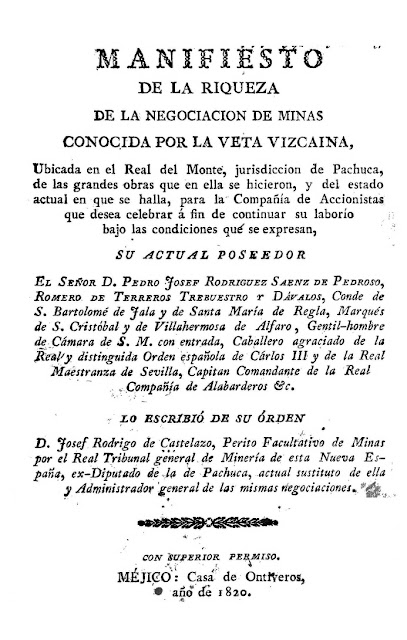
 Juan Bautista Castelazo Díaz, the second son of Rodrigo Castelazo Piña and María Rita Díaz, deserves a special mention for at least three reasons: for having been one of the first Castelazos to arrive in Guanajuato, for having married the granddaughter of the II Marquis of San Juan de Rayas and for being the father of Juan Bautista Castelazo Alamán, one of the most famous members of our family. The first Juan Bautista was born on November 27, 1820 in Real del Monte, Hidalgo. That year his father wrote the famous "Wealth of the Biscayan Vein", being the general administrator of the mines of the Count of Regla. He was born into a family in which there were great differences in age. His father was 53 years old, his mother 23 and his two older half-siblings, Francisca 26 and Ignacio 24 were his godparents at baptism. The first documentary record I have found of Juan Bautista Castelazo Díaz as an adult is a list of passengers on the ship "S.S. Europa", which arrived...

6. Arrival in Guanajuato

 The history of the Guanajuato branch in the family tradition linked it to one of the two mythical Italian brothers who would have arrived in Mexico many, many years ago. The records have clarified that there were no such brothers but that they were the descendants of each of Rodrigo Castelazo's two wives, although, curiously, during his lifetime there is no data that links our patriarch with the state of Guanajuato. The first record I have of the relationship with Guanajuato is in the marriagecertificate of Pedro , the fourth son of the Castelazo Díaz, who in January 1851 married in that city and declares that he has been living there for 7 years, that is, since 1844. Juan Bautista, the son number two of that marriage, apparently arrived together with his brother because in his marriagecertificate of February 1860 he declares that he has lived in Guanajuato for 16 years: again the subtraction takes us to 1844. Finally, also according to the data of his marriage certificate , in ...

5. Rodrigo Castelazo Piña (2) (English)

Imagen
 Rodrigo Castelazo was widowed at the age of 49, in charge of eight children between the ages of 8 and 22. I suppose that the eldest daughter, Francisca, found herself in need of taking an active role in the care of the house and her siblings, although the other older brothers, Ignacio, 20, and Manuel, 17, were also old enough to help in the plight faced by a family that loses its mother. Josefa died in Huasca, Hgo ., when Rodrigo was already working in the mines of Real del Monte, owned by the III Count of Regla, Don Pedro José María Romero de Terreros y Rodríguez de Pedrozo. The names of the three Counts of Regla are very long and similar, so I make a brief parenthesis to clarify who is who. These names are made very complicated by the custom of noble families to use the two surnames of their fathers and to lengthen theirs more and more in each generation, sometimes in one order and sometimes in another. Here I will use the style used in the Geneanet page of Sanchíz y Gayol . ...

4. José Rodrigo Castelazo Piña (1) (English)

The Rodrigo Castelazo who appears as the head of the original family tree had a long and interesting life, with incidents and vicissitudes that we can sometimes know and sometimes guess, from the genealogical records. Fortunately, we have the letter   (see the English translation here )  that José Rodrigo Castelazo wrote to the newspaper "El Sol", in 1827 , in which he tells us many details of his life. In his Birth certificate his name is read as "Joseph Rodrigo" but in his marriage certificate with Josefa Badillo he already declares his name as "José Rodrigo Castelazo". Our famous ancestor was born in Tlalpujahua, Mich., and was baptized on October 21, 1767. His parents were José Francisco Castelazo and Teresa Piña and his paternal grandparents Rodrigo Castelazo and Casilda Pérez. Rodrigo tells us in his letter that his family was dedicated to mining since they arrived in Mexico in 1620. Tlalpujahua at that time was a mining town and he dedicated him...

3. The Castelazos, do we come from Italy?

Imagen
 The answer to this question was recently clarified with the discovery of a letter  (see the English translation here ) that José Rodrigo Castelazo wrote to the newspaper "El Sol", in 1827, to respond to an insult from a curate. In this letter, José Rodrigo comments that his "ter-abuelo" (great-great-grandfather) arrived in Mexico in 1620, from Sicily. Another very interesting fact is the request for "composition of foreigner" made by Sebastián Rayo, father of Francisco and Nicolás Rayo Castelazo, in 1618 (see the originaldocument or for ease of reading the transcription  or the English translation ). For me it was very interesting to know this procedure of "composition of foreigners" because it refers to a method established by the government of Philip II to obtain financial resources. It was about giving foreigners who had entered New Spain without permission from the crown the opportunity to regularize their migratory situation by paying a ...